 Click the image or here for details |
|
|||||||||||||||
Search Results
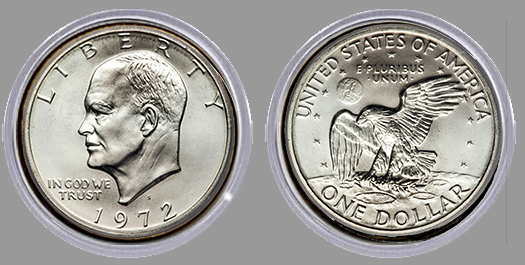
1945 Tribute to President Dwight D. EisenhowerThe Eisenhower Dollar, often called the “Ike Dollar,” was minted by the United States from 1971 to 1978. It honored President Dwight D. Eisenhower, the nation’s 34th president and World War II Allied Supreme Commander, and also commemorated the Apollo 11 Moon landing — a defining American achievement of the era. 1969 — Congressional approvalAfter the Peace Dollar ended production in 1935, the U.S. went more than three decades without a circulating dollar coin. 1971 Introduction of the Eisenhower DollarDesign and Symbolism
1975–1976 Bicentennial IssueTo celebrate America’s 200th birthday, the 1975–1976 Eisenhower Dollars featured:
1978 End of CirculationPublic acceptance of the large, heavy Eisenhower Dollar was limited — it was often considered too bulky for daily use. Legacy and CollectibilityThe Eisenhower Dollar endures as a symbol of American pride, leadership, and exploration — bridging the eras of World War II, space travel, and modern coinage.
Notes: This timeline highlights major design & composition changes. For full details and mint-by-mint variations (errors, proof sets, and special editions), consult U.S. Mint archives or numismatic guides.
Sources: U.S. Mint historical pages, numismatic references.
|